
San Bernardino County Previous Residents by Era
No single San Bernardino County record names all previous residents connected to an address. A deed index is about recorded parties, a parcel record is about land and tax information, a directory is about a dated address association, and a census is about a household at enumeration time. The era table below keeps those roles separate before the search begins.
| Source | Years It Covers | Where Held | What It Shows |
|---|---|---|---|
| Assessor govPIMS parcel search | Current and historical parcel data | ARC Public Assessor Map | Situs, APN, current owner, owner history, legal description, and parcel history |
| Recorder Official Public Records index | 1925-present | ARC official-record page and self-service index | Grantor, grantee, title, date, and document number; no online images |
| Recorder chain research | 1958-present | Online candidates plus office inspection | Practical chain-of-title work matched to legal descriptions |
| Earlier recorder indexes and deed books | Pre-1958, decade microfilm | Main Recorder office | Older name-index and deed-book evidence |
| Historical lot and parcel books | 1895-c.1950 | County Historical Archives | Taxpayer, tract or lot, values, and improvement entries |
| San Bernardino city directories | 1887-1968 | California Room | Names, addresses, household clues, and printed conventions |
| Criss-cross directories | 1976-present | California Room | Address-first names by street and house number |
| Telephone books | 1918-present | California Room | Household and address continuity where listed |
| Federal census | Through 1950 | Public under the 72-year rule in 2026 | Occupants, relationships, and household details |
| Building permits | Generally c.1936-present; cities vary | County Land Use Services or city offices | Construction chronology and applicant or owner evidence |
| Probate proceedings | 1853-1926 | County Archives and court channels | Decedent, heirs, executors, notices, and property references |
| Great Registers | 1866-1908 | County Historical Archives | Election-era resident descriptions that vary by year |
| Local newspapers | 1891-1998 digitized; microfilm 1894-present | CDNC and California Room | Notices, addresses, marriages, moves, and obituaries |
Start with the source that matches the question. An address from today belongs in govPIMS first. A prior owner belongs in the recorder index. A household from the directory era belongs in the California Room shelf, and the previous residents trail may lead a deceased resident to probate, cemetery records, or an obituary.
San Bernardino Past Residents: Address Records Start
The San Bernardino County govPIMS parcel search converts a situs address into the APN, current owner, and exact legal description needed for older research. Use Address Search, open Property Info, then check Owner History and Parcel History. Capture the APN, owner name, acquisition or document dates, document numbers, parcel status, and legal description before moving to the recorder.
An APN is a 13-character parcel number. For previous residents, the parcel record can connect an address to land, but it does not prove that every person at the address is an occupant. A mailing address can be different from the situs address, and ARC may suppress owner or mailing fields under Government Code sections 7928.200-7928.205. Treat a suppressed field as a privacy boundary, not as a missing search trick.
| Situs address | The physical location used to find the parcel in the assessor search. |
|---|---|
| Mailing address | A tax or correspondence destination that may be off-site or protected. |
| Legal description | The tract and lot, or section-township-range wording that identifies the land in a deed. |
| Parcel history | Events such as parcel changes or combinations that may explain why an old lot differs from today’s parcel. |
San Bernardino Past Residents: Deed Records Backward
The recorder cannot search ownership by street address. After govPIMS supplies the current owner and legal description, use the ARC Official Public Records page and its linked index. The county's property-research guide supplies the same backward-chain handoff: search the current owner as grantee, match candidate documents by legal description, take the grantor or seller, and repeat backward.
- Record the current APN, owner, exact legal description, and document numbers from the assessor parcel report.
- Search the current owner as grantee in the recorder index and compare the candidate document title, date, and land description.
- Take the matched grantor name from that acquisition instrument and search the grantor as a later grantee.
- Repeat the handoff backward, keeping every seller, buyer, document number, and legal-description match in sequence.
- When the search reaches the earlier boundary, move to the recorder office's decade microfilm or deed books rather than treating the online cutoff as the county's first deed.
- Grantor
- The party transferring an interest in a recorded instrument.
- Grantee
- The party receiving the interest in that instrument.
- Chain of title
- The linked sequence of transfers for the same land, checked from one instrument to the next.
- Legal description
- The formal land identifier used to prove that a name-index candidate concerns the same parcel.
Researching previous residents still depends on the recorder index's party name and recording metadata. It does not search by legal description, so the description is the check that keeps two similarly named parcels apart.
San Bernardino Past Residents: Recorder Record Cutoffs
Two local statements describe different parts of the same access problem. The official recorder page says the index reaches 1925-present. The county property-research guide describes online and office chain research from 1958-present, with pre-1958 decade microfilm. Preserve both statements: 1925 is the broad published index reach, while 1958 is the practical documented chain-of-title boundary.
The recorder self-service disclaimer compares the index to a library card catalog and tells searchers to try spelling variations. For previous residents, online images are not available. Inspect them at the Hall of Records or High Desert Government Center, or order copies through the live official-records and office channels. Appointments are strongly encouraged.
The current fee details are $4 for the first page, $1.50 for each later page, $1.50 per page for a seal, and a 3.5% card surcharge. From July 1, 2026, mail is listed at $3.50 standard or $29 priority. Mail goes to San Bernardino County Recorder, 222 W. Hospitality Lane, 1st Floor, San Bernardino, CA 92415-0022, with a stated one-to-two-week turnaround. The older copy-form URL is now unreliable, so use the live official-records page and the office or copy-order channels instead.
The official records access page is also the best place to confirm current copy instructions before sending a request.
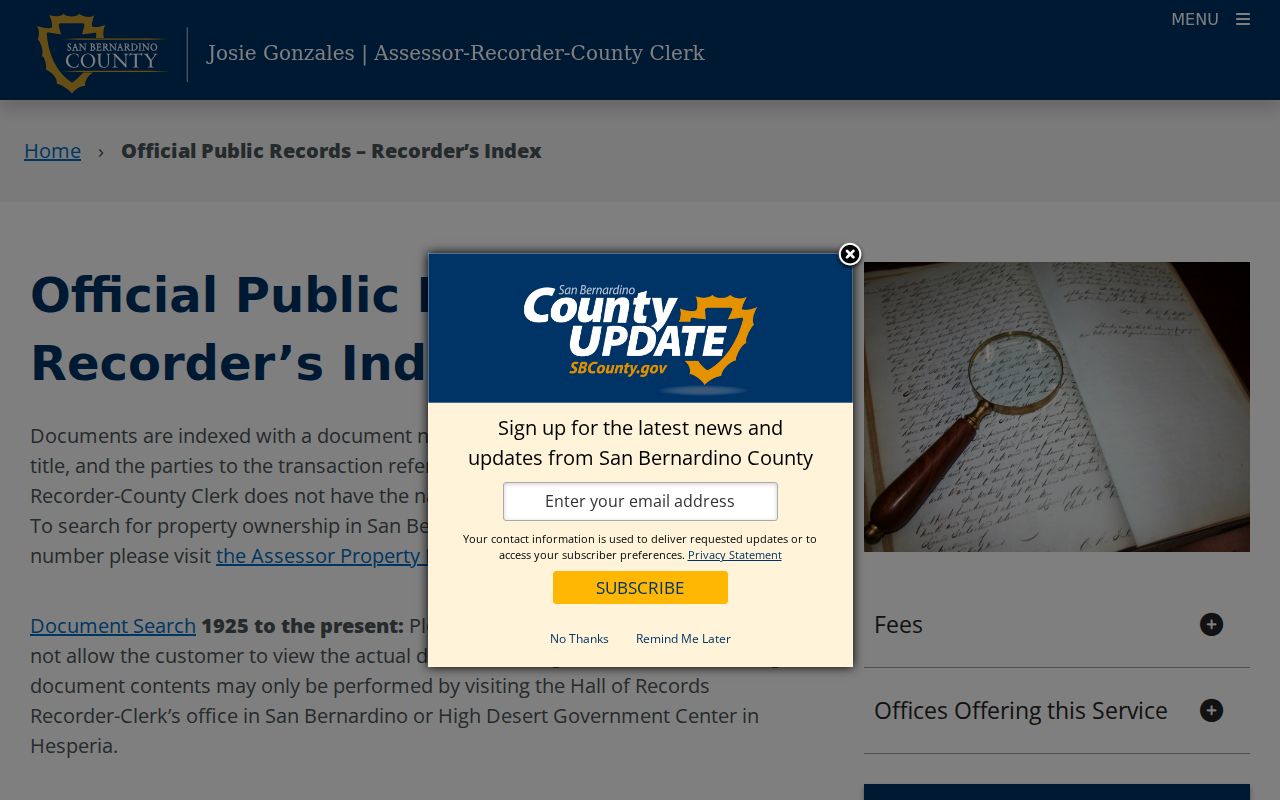
The recorder screen is a finding aid. A paid copy or office inspection is the step that lets a researcher read the instrument itself.
Note: A recorder index hit identifies an indexed party and instrument, not proof that the person was a current resident.
San Bernardino Past Residents: Lot Records and Permits
Historical lot and parcel books reach from 1895 to about 1950 and can show a taxpayer, tract or lot, land values, improvement values, trees or vines, and water values. The first appearance of an improvement can help place a structure in time. It cannot tell whether the improvement was a house, barn, or shed, so the entry needs cautious support from another record.
Deeds convey land, not buildings. Building permits are a better construction trail when they survive. County permits generally begin about 1936, while incorporated cities may hold earlier or separate series. County Land Use Services and city building offices are therefore different custodians, and a permit search should follow the jurisdiction tied to the address.
The County Historical Archives description gives the current assistance route. The building is marked closed, with help available at ARC-DLRecArchive@arc.sbcounty.gov or 909-387-1001.
For map context, the Library of Congress Sanborn map collection is a broad historical resource. Do not infer a local San Bernardino year run from the national collection description; confirm local coverage first.
San Bernardino Previous Residents in Directories
Printed San Bernardino city directories run 1887-1968 in the California Room inventory. Criss-cross directories begin in 1976 and run to the present, while telephone books begin in 1918. The printed and reverse runs leave a documented 1969-1975 gap unless staff confirms another source. That gap is a reason to test newspapers, census records, maps, and personal names in more than one form; it also keeps the previous residents question tied to a date.
Use the printed run by name index, then record the street, house number, spouse, initials, widow entry, occupation notation, and any abbreviation exactly as printed. Use the criss-cross run by street and number for the later address-first period. A directory can show a previous resident associated with an address, but it does not establish title. For collection details and entry conventions, the San Bernardino County directory book keeps the historical shelf separate from the deed trail.
When a name disappears, test a move, death, omitted volume, changed spelling, spouse entry, or changed street label. A single missing line does not tell which explanation is correct.
San Bernardino Past Residents in Census Records
Federal census schedules through 1950 are public under the 72-year rule in 2026. A census can show occupants and relationships at enumeration time, while a city directory may show a nearby year and a more exact street address. Pairing a 1940 census with a 1942 directory, or a 1918 telephone book with the 1920 census, can turn a thin address clue into a dated sequence.
Local newspapers fill the years between those snapshots. The California Digital Newspaper Collection covers title-specific runs from 1891-1998, and California Room microfilm runs from 1894-present. Search the San Bernardino Sun, Weekly Courier, Weekly Sun, Evening Transcript, and Evening Index and San Bernardino News with the street, town, spouse, and name variants. Printed and microfilmed obituaries can close a trail, but they should be read with cemetery and probate evidence.
Probate proceedings from 1853-1926 can name a decedent, heirs, executor, property, debts, and notices in public portions. A probate file is an endpoint or relationship clue, not an invitation to publish a living person's address.
Past Residents and Route 66 Across San Bernardino
Street names change across this large county, so a search for past residents can fail when the place is right but the label is old. Historic Route 66 and National Trails Highway use different names in different communities. Test each name with the town and a house number before deciding that a directory or newspaper has no match.
| Area | Street label to test | Search clue |
|---|---|---|
| San Bernardino | Fifth Street | Use the historic name with directional prefixes and early maps |
| Barstow | Main Street | Also test earlier names Grapevine and Camp Sugarloaf |
| Victorville | 7th Street | Keep the town name beside the street variant |
| Upland, Rancho Cucamonga, Fontana, Rialto | Foothill Boulevard | Compare the city and county context for the same corridor |
| Countywide corridor | National Trails Highway | Use route history as a second label, not a replacement for the address |
Helendale and Silver Lakes provide another geography clue: USPS uses Helendale while Census uses Silver Lakes. Test both names in census, ZIP, property, directory, and newspaper searches when an address sits in that area.
San Bernardino County House History Help
The Arda Haenszel California Room is inside the Norman F. Feldheym Central Library at 555 W. 6th Street, San Bernardino, CA 92410. Call 909-998-4251 first because special-room hours are shorter than the main library schedule. Posted hours are Monday and Tuesday 2-4 p.m.; Wednesday 10 a.m.-3 p.m.; Thursday 2-4 p.m.; Friday closed; Saturday 2-4 p.m.; and Sunday closed.
Mail research costs $20 per hour or any part of an hour, plus $0.25 per copied page. Give a specific date with month, day, and year, along with other pertinent facts, and mail the question to the same library address. The room's maps, family histories, telephone books, school annuals, obituaries, cemetery records, and directory shelves can make a past household easier to place.
The County Archives can be reached at ARC-DLRecArchive@arc.sbcounty.gov or 909-387-1001 for lot books, probate, and Great Register questions. CSUSB Special Collections is another local custody point for regional archives, photographs, maps, rare books, university records, and ephemera. Contact archives@csusb.edu or 909-537-5112 at Pfau Library PL-4009, 5500 University Parkway.
Past San Bernardino Households
Past residents are best understood as a sequence of dated clues rather than a single answer. Use the parcel to hold the land steady, the deed chain to follow recorded transfers, the directories and census to locate people, the newspapers to explain movement, and probate or obituaries to close an older trail. Keep each source's limits beside its result.
A compact process is: known address to APN; APN to current owner and legal description; current owner as grantee; prior seller as grantee; earlier microfilm or lot book; directory and census pairing; newspaper, obituary, cemetery, or probate check. The sequence distinguishes an owner from an occupant and a historical clue from a current conclusion.
Lawful use. Previous-resident research in San Bernardino County is for house history, family history, and personal curiosity. Do not use records to stalk, harass, track, or harm a living person.
When a source is silent, protected, or unavailable, stop at that boundary and use the custodian's lawful access route. A careful record trail is more useful than a confident guess about who lived at an address.