
San Bernardino County City Directories
San Bernardino County has a defined historical directory shelf, but its published span is not a promise that every annual volume survives. The California Room's San Bernardino County city directory shelf supplies the main local range, while the verified 1942 item and the address-first run add different ways to follow a household.
| Collection | Years | Where Held | Access |
|---|---|---|---|
| San Bernardino printed volumes | 1887-1968 | Arda Haenszel California Room | In-room or mail research |
| San Bernardino Directory Co.'s San Bernardino city directory: including Colton and Rialto | 1942 | FamilySearch film 1320664, item 3; DGS 7968292 | Digitized microfilm; account or affiliate limits may apply |
| Criss-cross directories | 1976-present | California Room | Address-first research in person |
| Telephone books | 1918-present | California Room | In-room reference |
| Local Sunday newspaper microfilm | 1894-present | California Room | Microfilm; related titles are digitized |
| San Bernardino County Great Registers | 1866-1908 | County Historical Archives | Archive assistance and in-house research |
The 1887-1968 span is the useful starting point for a name-first search. It should not be read as a complete year-by-year shelf list. The stated printed run ends in 1968, and the stated criss-cross holdings begin in 1976, leaving a documented 1969-1975 address-first gap unless staff identifies another run. The FamilySearch catalog record independently verifies the 1942 title and its film details.
San Bernardino County Directory Room
The Arda Haenszel California Room sits inside the Norman F. Feldheym Central Library at 555 W. 6th Street, San Bernardino, CA 92410. The room is the strongest local starting point for historical directory research, but special-room hours are shorter than the main library schedule. Call 909-998-4251 before making a trip.
Posted hours are Monday and Tuesday, 2-4 p.m.; Wednesday, 10 a.m.-3 p.m.; Thursday, 2-4 p.m.; Friday closed; Saturday, 2-4 p.m.; and Sunday closed. Mail research costs $20 per hour or any part of an hour, plus $0.25 for each copied page. A request should give a specific date, including month, day, and year, along with other pertinent facts. Mail it to San Bernardino Public Library, Research Question, 555 West 6th Street, San Bernardino, CA 92410.
The room also holds the Great Register of San Bernardino County for 1880-1886, incomplete marriage, birth, and death records through 1910, San Bernardino and Riverside census records for 1850-1920, printed and microfilmed obituaries, and San Bernardino Valley Genealogical Society quarterlies from 1962-present. Pioneer and Agua Mansa cemetery records, San Bernardino High School annuals, the Mary Lewis early-settler collection from 1853-1909, early maps, diaries, family histories, photographs, and pioneer biographies can supply context when a directory entry is brief.
The Arda Haenszel California Room listing is the source for the room's holdings, contact details, and access caution.
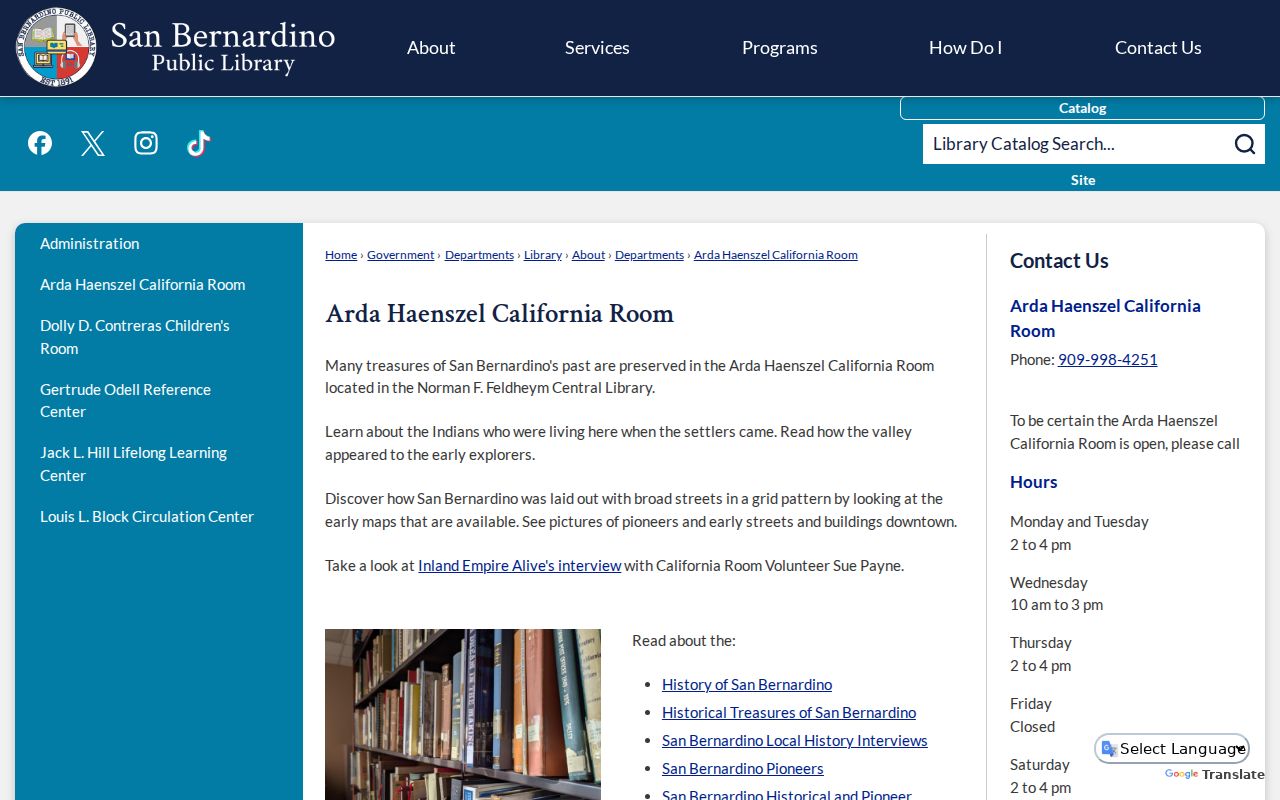
The room's mixed shelves matter because a missing directory year can sometimes be bridged by a telephone book, census image, obituary, school annual, or local map. A city directory can be paired with those sources to test an address without treating one volume as complete.
Note: The library lists collection spans, but a complete annual survival list should be confirmed with California Room staff.
Verified 1942 San Bernardino Directory
FamilySearch verifies San Bernardino Directory Co.'s San Bernardino city directory: including Colton and Rialto for 1942. The catalog identifies film 1320664, item 3, and DGS 7968292. That exact title is useful when a search concerns San Bernardino, Colton, or Rialto in the same period, since a county name alone can hide the volume's stated geographic scope.
Digitized microfilm access can require a FamilySearch account, a FamilySearch Center, or an affiliate library. Contract restrictions may keep some images from open home viewing. This city directory's film record proves that the item was described and filmed; it does not guarantee that every image is unrestricted. Record the title, year, film number, and item number with each finding so another researcher can reproduce the search.
Printed and online newspaper sources widen the digital trail. The California Digital Newspaper Collection at cdnc.ucr.edu carries several local titles with overlapping dates, while the California Room keeps local newspaper microfilm. A directory clue can therefore be checked without treating one digitized volume as the whole county record.
Reading a San Bernardino City Directory Entry
A San Bernardino County city directory entry is a compact clue, not a finished biography. The printed line may connect a name to an address, spouse, occupation, or abbreviated association. Copy the line as printed before expanding an abbreviation or normalizing initials. That habit protects the distinction between what the volume says and what later research suggests.
| 1913 directory | J. S. Bostwick, painter |
|---|---|
| 1920 census pairing | John S. Bostwick and wife Etta, house painter |
| 1930 census pairing | John Bostwick |
| 1942 Colton directory | Albert Harper, wife Dixie, cement worker |
| 1949 Colton directory | Melvin C. Evans, wife Marjorie, “Dispr. S.P. Co.” |
| Household status | Use any owner or occupant mark only when that volume explains it in its own key |
These examples show the fields that can matter in a historical entry: initials, a full name in a census pairing, spouse, address association, occupation, and an employer or organization abbreviation. “Dispr. S.P. Co.” likely means dispatcher for Southern Pacific, but the expansion should be checked against the 1949 volume's abbreviation key. It should not be silently changed in a transcription.
- Name index
- The name-first section used for the 1887-1968 printed range; it points a researcher toward a person and address.
- Criss-cross directory
- An address-first arrangement, usually searched by street and house number, rather than by surname alone.
- Abbreviation key
- The volume's own legend for shortened occupations, organizations, and other marks; check it before interpreting a line.
- Household status mark
- A symbol or note that may appear in a particular run; absence of a mark should not be treated as a conclusion.
San Bernardino Criss-Cross Directories
The California Room lists criss-cross directories from 1976-present. For a city directory search, their address-first order changes the question: instead of asking where a known surname appears, a researcher can start with a street and house number, then note the name printed for that location. The result still needs context from census, newspaper, parcel, or deed records.
The gap between the printed span and the criss-cross start is a useful warning. Printed volumes are listed through 1968, while the reverse run begins in 1976. The research record documents 1969-1975 as a gap unless California Room staff finds an unlisted volume. Telephone books, which are listed from 1918-present, may help bridge address or surname changes, but they should not be assumed to cover every household.
| Period | Record shift | Search use |
|---|---|---|
| 1887-1968 | Name-first printed shelf | Find a person, then read the address and nearby entries |
| 1969-1975 | Documented gap in the stated runs | Ask staff about another holding; test telephone, census, and newspapers |
| 1976-present | Criss-cross address-first shelf | Start at street and number, then verify the printed name |
Note: A gap in the published run is a prompt to verify another source, not proof that no local volume exists.
Pair San Bernardino Directories with Census
Directory years become more useful when paired with nearby census years. A printed volume can add an address or a spouse between census snapshots, while a census can test the household composition implied by a directory line. Federal census records are public through 1950 under the 72-year rule in 2026, and the California Room holds San Bernardino and Riverside census records from 1850-1920.
Use the same spelling discipline in both sets. Preserve initials, hyphens, widow entries, and street directions. If a person disappears, test a move, death, an unlisted year, a spouse's name, or an address change before deciding the household ended.
- Start with a known year, name, address, or spouse and write down the exact printed form.
- Use the 1887-1968 name index, then check the business or classified section when an address or organization may be the better clue.
- For 1976 forward, switch to the criss-cross section and search street plus house number.
- Pair a 1940 census with a 1942 directory, or a 1918 telephone book with the 1920 census, then compare dates and addresses.
- Search newspapers for arrivals, marriages, advertisements, obituaries, and address notices that explain a change.
- Use probate, cemetery records, assessor material, and deeds to separate a directory association from ownership or a death endpoint.
A directory entry can link a person to a place without proving title. The reverse is also true: a deed can name a property party without showing every person who lived there. Matching independent records makes the family-history conclusion stronger.
San Bernardino Directory Gaps in Newspapers
Local newspapers are a bridge when a printed volume skips a year or uses a hard-to-read abbreviation. The California Digital Newspaper Collection provides an overlapping set of San Bernardino titles: Evening Transcript, 1898-1902; Evening Index and San Bernardino News, 1912-1918; San Bernardino Sun, 1894-1998; Weekly Courier, 1891-1894; and Weekly Sun, 1895-1905. Search the exact name, initials, street, spouse, business, and town variant.
The California Room's local Sunday newspaper microfilm runs from 1894-present, and its holdings include printed and microfilmed obituaries. A newspaper search can locate a marriage notice, arrival, advertisement, move, or death notice, but an absence is not proof that an event did not happen. Search the name with address variants and try the newspaper title that overlaps the directory year.
Printed newspapers also preserve neighborhood language that a directory omits. A short notice may connect a family to a church, school, cemetery, or civic group. Those links can point to the California Room's San Bernardino Valley Genealogical Society quarterlies, school annuals, or family histories without turning one directory entry into an unsupported identity claim.
San Bernardino Directory Archives
The County Historical Archives add official material beyond the library shelf. Current holdings include lot and parcel books from 1895 to about 1950, probate proceedings from 1853-1926, and Great Registers from 1866-1908. Great Register entries can vary by year, but may include occupation, age, height, physical description, and naturalization status. Probate can name spouses, children, executors, heirs, property, and debts in public portions of a case.
The Archives building is currently marked closed. Assistance is available through ARC-DLRecArchive@arc.sbcounty.gov or 909-387-1001. The Arrowhead/ArchivEra catalog at the county historical search portal supports a keyword box, Advanced Search, Browse Subjects, and Browse Collections. Use an asterisk for truncation, such as arch*, and do not use quotation marks. The catalog describes holdings; it is not proof that every underlying image can be viewed online.
The Arrowhead/ArchivEra catalog view is the source for the archive image, while the County Historical Archives access page explains the current contact route and record groups.
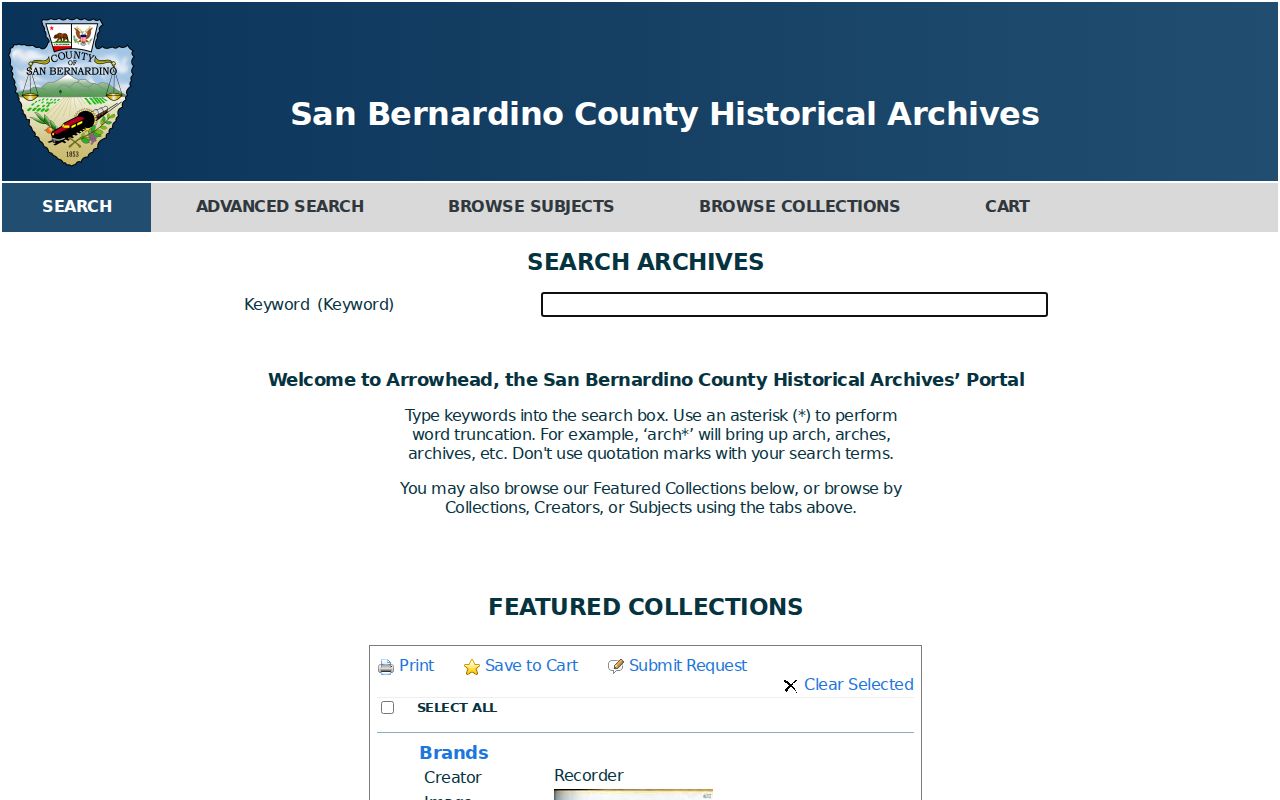
Archives descriptions are most useful when a directory clue already has a date, surname, parcel, or case reference that can be tested in the named record group.
San Bernardino Directory History Survived Fire
The Pioneer Log Cabin fire destroyed portraits and the original name index, but firefighters saved a box of negatives. The negatives were later found at the fire station and moved to the library. Mary L. Lewis compiled replacement binders with portraits and brief descriptions, and copies are held in the California Room and by the City of San Bernardino Historical and Pioneer Society. A 2006 California State Library LSTA grant funded digitization.
That chain of loss and reconstruction explains why local memory may sit in a binder, photograph collection, or oral-history project instead of a clean name index. The city library's oral history about Sue Payne describes a resident learning in 1995 that she had been adopted and using California Room research as part of her identity story. The human use is personal and lawful: family connection, memory, and context.
CSUSB Special Collections adds regional archives, photographs, maps, rare books, university records, and ephemera. It can be reached at archives@csusb.edu, 909-537-5112, Pfau Library PL-4009, 5500 University Parkway. Its community projects and local photographs can preserve names, streets, and buildings that formal directories never captured.
The County historical archives reference places that survival story within San Bernardino County's wider records history.
The historical-archives view reinforces a practical point: a resident trail may require both a printed directory and a custody story about how local records survived.
Trace Beyond San Bernardino City Directories
A useful city directory result is a starting point for a wider household trail. Keep the volume title, page, year, name form, address, spouse, and any abbreviation together. Then compare the same address with census schedules, newspapers, cemetery records, probate, and official parcel material. That order keeps a historical clue distinct from a later assumption.
County formation matters. San Bernardino County was formed on April 26, 1853. Marriage records from before the county existed point to Los Angeles County, while local probate holdings begin in 1853 and county Great Registers survive from 1866. The California Room's maps can help reconcile an early lot or street label with a later numbered address.
When the goal shifts from a historical entry to present address records, the San Bernardino County street directory route uses the current parcel and address angle. A directory remains valuable, but its strongest role is to show a person and place at a dated moment, then hand that clue to the record set that can confirm the next part of the story.